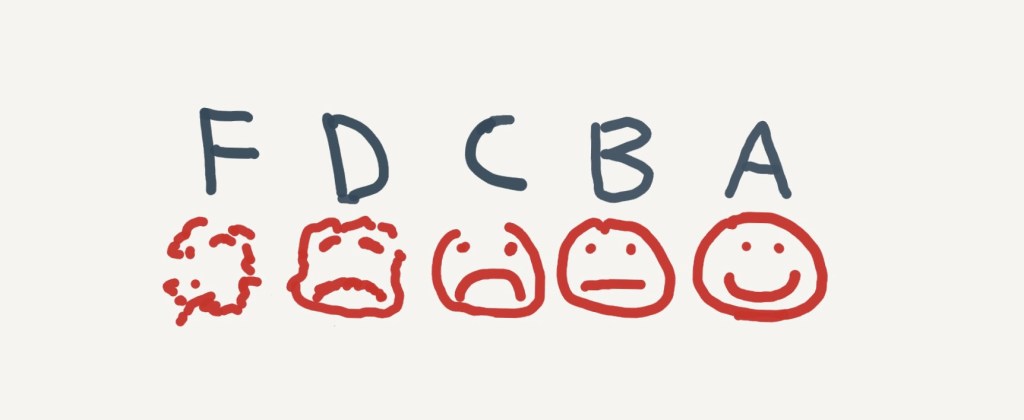
GRADING
I have seen my mom come home on several occasions and just be drowned on the couch with paperwork, and this is for FIRST GRADE WORK. When I think about it, I can’t imagine there is that much work to be graded, but without fail it seems that there always is. Before reading chapter 17 of See Me After Class, I had not really thought about grading taking up so much time, but more of things like lesson planning and getting materials together. But after reading the chapter, I realized that many teachers are drowned on the coach on a daily basis, on top of lesson planning and all of those other things. I knew that it would definitely be helpful to have strategies to manage this now, especially if I was wanting to do a high school class that was more grading-intensive.
Some of the best advice that I found in chapter 17 of the book was that not everything you do in class needs to be grading. There should be room for students to really try to grasp a concept without worrying about it being graded, and it helps you because you don’t have to grade these. Besides, why should you grade something that, when in the beginning stages, is going to need a lot of feedback and time from you. Why not wait until students have a greater grasp of the concept? But then comes the idea that if you don’t place incentive, most commonly a grade, upon the students, will they even do the practice you spent time making for them? That’s when the book’s idea about giving quick completion points comes in handy I also think. But I also feel like this incentive does not have to be solely grade-based. You could use an assignment for a chance for students to unlock extra credit or a pass on a part of another assignment that would actually be graded. I think grades don’t need to always be used and you could save yourself a lot of time and trouble if you didn’t use them all of the time on each thing you had students do in class. But there comes a time when you must actually give grades since they are still a really good way to judge learning, and the book also listed ideas to help you when you are essentially forced to grade.
When actually grading, I thought the idea of splitting grades into pieces of the assignment was a great idea. The book said that when you gave an assignment, you ask that students complete all parts of the assignment and when you grade, you focus on one specific concept or piece of the assignment. I feel that if, when you start a unit, you look at all of the assignments you will give, you can break up all the assignments into all of the concepts they need to learn and make sure between all of them you are assessing them on the ideas once. So in that case you would not have to grade all of the work, but you are still making sure that all of the students understand and receive credit for learning the information. Another thing that I liked was assigning multiple things and only grading one. For example giving three types of essays for students to write in a window of time, and then picking one for them to grade, or even letting them pick which was their best work. That way they get the practice with all different types of writing but you are not grading as much. Overall I think there are so many ways for kids to get the most of out classwork without you, the teacher, being stressed about making sure they all are.

TESTING
In chapter 16 of See Me After Class, the author also talks about a dreaded thing that is ever-present in the school system: testing. Students don’t like it, teachers don’t like it, it really is no fun for most, but it has become a central part of the school system. She focuses more on large state or nation-wide testing, and ways to cope with getting through this testing as calmly as you can.
There were a lot of extremely useful things she said, my favorite of those being the idea that testing should not be made a huge deal and neither should the results of the test. I know that there is not mandated testing in agriculture classrooms but I feel that there are some things that I can do to still enforce this idea within the class curriculum. I have found that in high school there is so much pressure on tests and they make secondary level students extremely stressed. For me, they are some of the biggest stressors throughout the year. One thing that I hope to do in my ag class is to not do routine tests as much as doing “tests” like executives would to evaluate a person in the agriculture industry. I want to integrate regular tests and teach students testing strategies in the class, but I also want these types of evaluations to take some of the pressure off. For instance, there are a lot of jobs in each field of the industry that are required to sell agriculture products, so for one of their tests they would use their knowledge from the class (plant, animal, etc…) and with a given scenario they must sell something to a client. I would want these to low stress and feedback based so students have time to work on it and practice these skills for real world experience. I hope that I can make tests and evaluations a learning curve and help students realize that this knowledge will help them in the future.
Another thing I want to do is, though they might not be completely relatable to the class, teach some test taking strategies. I want to make sure the class is the best environment for preparing for the future so I want to take time out of class to work on college information, study habits, and testing strategies. I want to do my best to make sure that we look at how they should study and give them the best mindset going into tests in other classes, as well as the future. I really liked the ideas that she discussed about preparing mindsets for students (putting less pressure on, knowing their best in enough, knowing it won’t always be a great test day, etc..). I also want to make sure they keep themselves healthy before a test like the author talked about in the book. Overall what I got from the chapter was that, yes, testing is highly emphasized in the school system and your content should be working at preparing students for the test, but it is really important to actually talk about testing and keeping students healthy for a test. I want to be sure that I am teaching the kids about how to take a test, along with the content. I think this chapter really showed me how important that idea is.
 Teaching Portfolio